How to prevent ice dams (and what to do when you see icicles)
Ice dams start inside your house, not on the roof. Warm air leaks into the attic, warms the roof deck and melts snow from below. That water refreezes at the cold roof edge and can back up under the shingles. The fix is to keep the roof cold: seal attic air leaks, add insulation and keep vents open. Mid-fall, before the first big Front Range snow, is the time to do it.
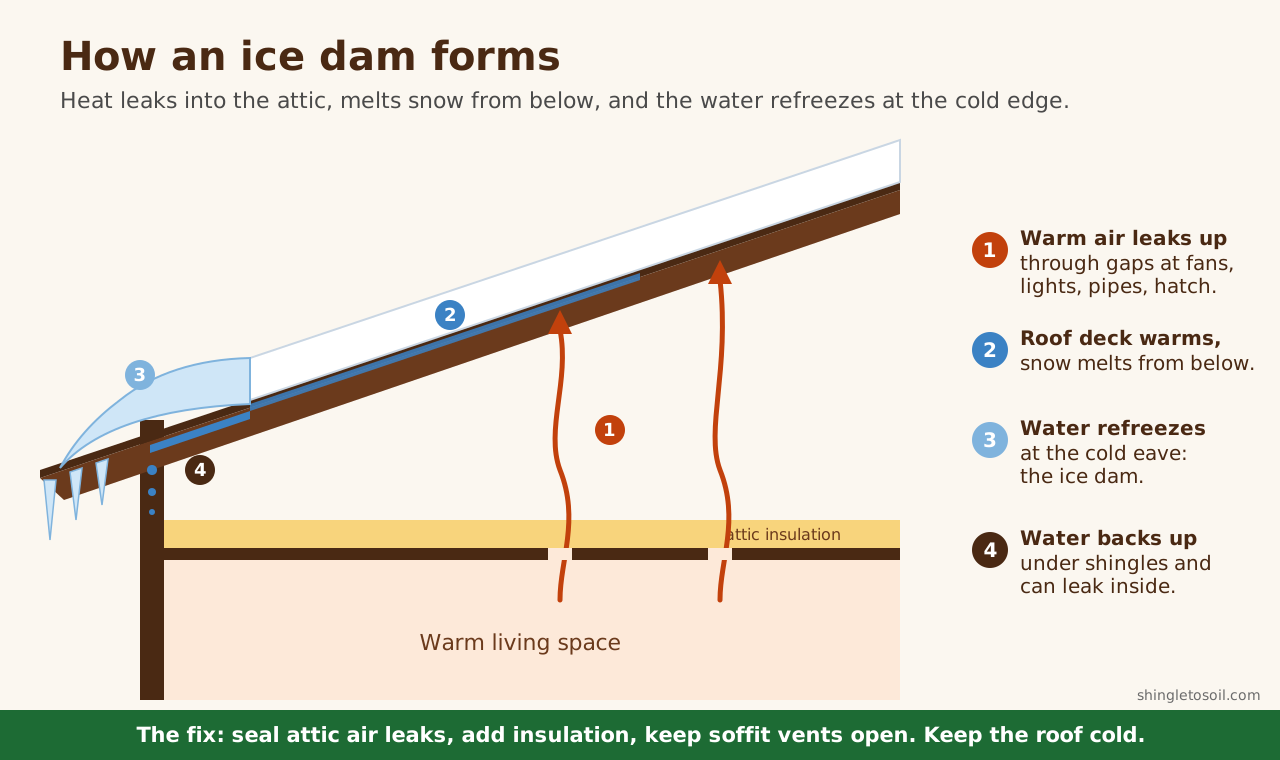
Step by step
Know the warning signs. Look for a thick ridge of ice along the roof edge, big icicles at the eaves, or water stains on ceilings near outside walls. Ice dams can form with only an inch or two of snow on a leaky, under-insulated roof.
Pick a cool, dry fall day for the attic. Bring your light, gloves and mask. Go up before snow arrives.
Hunt for air leaks. Warm air sneaks into the attic through holes in the ceiling. Check around bathroom and kitchen fan housings, recessed can lights, the attic hatch, plumbing vent pipes, electrical wires and the tops of interior walls. Dirty or dark spots in the insulation often mark a leak.
Seal the small gaps. Use caulk for cracks and low-expansion foam for holes around pipes and wires. Air sealing is the most important step, so take your time here.
Leave chimneys and furnace flues to a pro. They need fire-safe materials and clearances. Don't stuff insulation or foam around them.
Weatherstrip the attic hatch. Add weatherstripping around the edge and insulation on top of the hatch door.
Check insulation depth. Measure it in a few spots. ENERGY STAR recommends about R-49 when you already have 3 to 4 inches, and R-60 for an uninsulated attic, in climate zones 5 and 6. Much of the Front Range is in climate zone 5; check with your local building department. If you're far short, get quotes for added insulation.
Keep the vents open. Insulation should not block the soffit vents at the eaves. Baffles (vent chutes) hold it back and leave an air gap of about 2 inches under the roof deck.
Clean gutters and downspouts. Clogged gutters hold slush that freezes solid.
After a heavy snow, rake from the ground. Pull snow off the lower few feet of the roof with a roof rake. Stay on the ground, keep the blade gentle on the shingles and watch for power lines.
When you see icicles, check inside. Look at ceilings near outside walls and in the attic for damp insulation or wet wood, even if nothing is dripping yet.
Skip the shortcuts. Don't chip ice with picks, hammers or shovels; you can damage the roof and hurt yourself. Heat cables treat the symptom, not the cause. If you already have them, follow the maker's instructions, including ground-fault protection on the circuit.
Safety first. Step only on joists or boards in the attic; stepping between them can put a foot through the ceiling. Watch for roofing nails overhead. If your attic has loose, pebbly gray-brown or gold insulation, it may be vermiculite: the EPA says to leave it undisturbed and use a trained, accredited asbestos contractor to remove it. In winter, never climb onto a snowy roof, never chip at ice, and look up for power lines before you raise a roof rake.
When to call a pro
- Snow or ice can't be removed safely from the ground.
- Water is already leaking inside, or you find wet insulation or wood in the attic.
- Air sealing around chimneys or flues, or adding a lot of insulation.
- You suspect vermiculite insulation (use an accredited asbestos contractor).
- You're replacing the roof: ask about a self-adhering ice barrier at the eaves, which building codes require where ice dams are a known problem.